
The Hacker that Wasn't
The Exploits of "Michael Synergy," Transnational Man of Mystery
This month, allow me to offer you another questionable tale about Mondo 2000, the infamous 1990s magazine and scene that launched a specific brand of cyber-counterculture. For reasons that aren’t always clear to me, I am co-authoring a history of Mondo with former editor-in-chief R.U. Sirius (Ken Goffman). If you are only just joining our regularly scheduled program, here’s a quick summary of the Mondo 2000 project. Last month, I wrote about St. Jude Milhon. This month I get a bit spicy with the sordid tale of Michael Synergy.
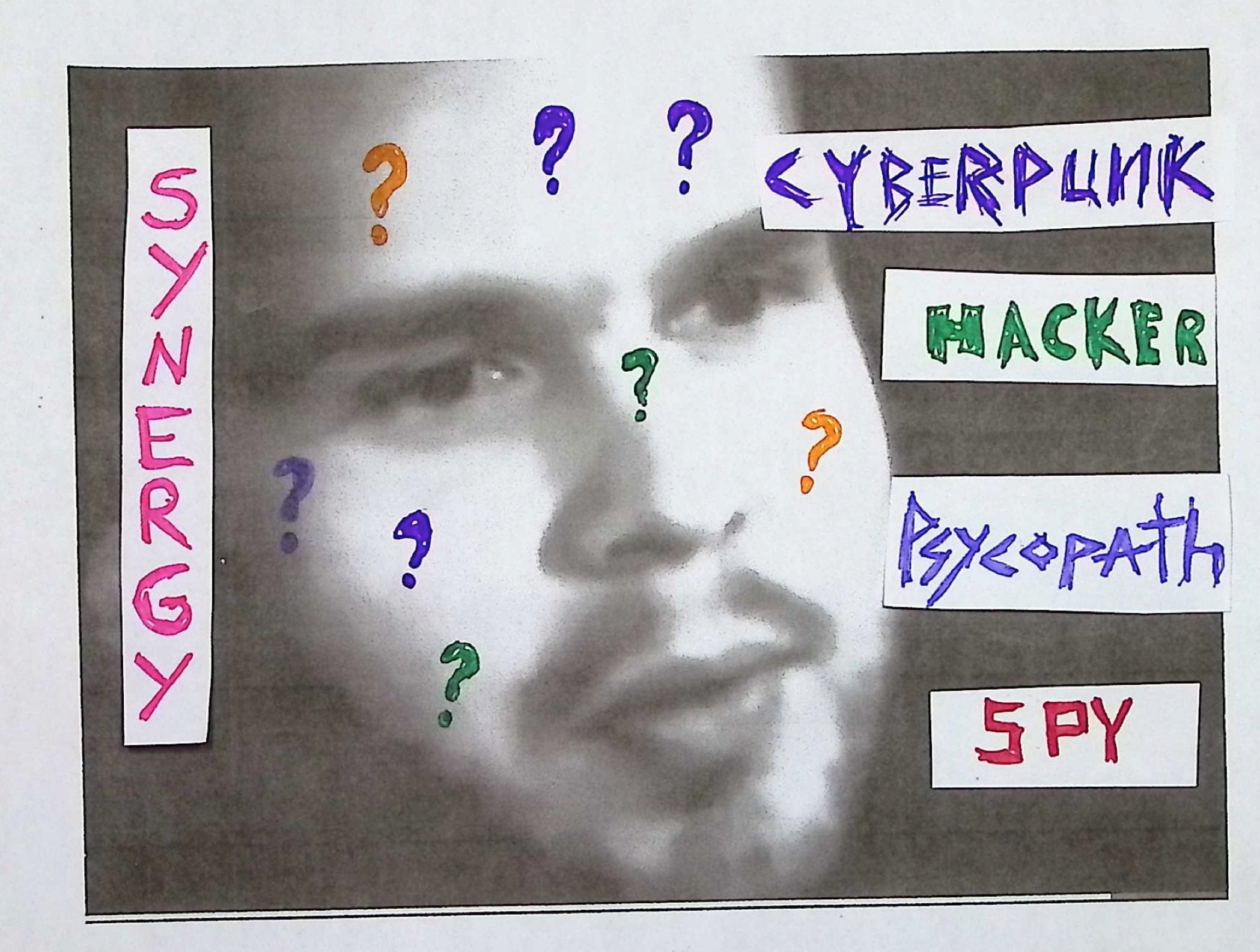
Cyberpunk Hacker Psychopath Spy
From the outset, I’m going to tell you that I know close to nothing about the person this article is about. Nothing. I’ve never spoken to him. I am dubious that I know his real name.1 I have some interview footage of him from a cyberpunk documentary that labels him a hero. I have some audio that is deliberately distorted.2 And I have about 800 truly insane stories, all Synergy-adjacent. I don’t know where he was from. I only have guesses about his age. I have no contact information for him and no idea what happened to him.
He may have been a hacker, but perhaps not a very good one. He may have been on the payroll of an military intelligence agency, but that might have been fabricated nonsense. He may have been psycho, but that might have been performative edge-lording. He may have been a 2010s television producer, but … also maybe not.
Let me tell you about the man who called himself “Michael Synergy.”
There are going to be two kinds of people reading this article. The vast majority of you have no idea who Michael Synergy is or was. Yet, I imagine there’s a sliver of audience who knew him personally or through his writing. If you have Synergy stories that are not in this post, I invite you to include them in the comments (although I’d prefer you not use his real last name).3
Synergy was an infamous character who became part of the Mondo scene in the late 80s, apparently via some combination of former editor Morgan Russell and VR pioneer Eric Gullichsen both of whom he worked with at Autodesk.4 If you are in the camp of folks that haven’t heard of Synergy, you might be questioning his import. But he was important, briefly. Synergy successfully exploited a moment in his publishings and recordings where he had everyone convinced that he was the next big thing, the new generation of hacker.
While I don’t know much about Michael Synergy himself – the man remains a genuine mystery to me – it is worth thinking about him in terms of what he represents in the late 80s and early 90s transition from geek-as-counterculture to geek-as-corporate. There, Synergy becomes one of many mysteries, a ghost of a character that sits somewhere within a Venn diagram between charismatic, eccentric, pseudo-intellectual, and technological.
“We have to synergize backward overflow”
In 2026, that word “synergy” is a punch line, a bro-adjacent nonsense corporate term that amounts to almost nothing. But the word has a surprisingly robust history before the corporate world. NPR recently broke down its etymology.
Here are the cliff’s notes:
The word has Greek roots, combining syn “together” and ergon “work.”
It first became regularly used in religious contexts (synergoi) to imply laborers working together.
By the 1800s it was used in medical contexts to describe organs working in concert.
By the mid-20th, it slipped into social sciences and pop psychology to describe the strength of groups working together.
Counterculture fav Buckminster Fuller wrote of Synergetics which he defines as “the cosmic logic of the structural mathematics strategies of nature, which employ the paired sets of the six angular degrees of freedom, frequencies, and vectorially economical actions and their multi-alternative equi-economical action options” – or how patterns in nature impact humans.
By the mid-60s it was introduced into corporate America by Igor Ansoff’s book Corporate Strategy to describe the collaborative work as greater than the sum of its parts.
By the mid-1990s, “synergy” morphed into the truly nonsense buzzword that we know today. Think boardroom presentations and meaningless white papers invoking “synergistic practices” to imply some transcendental workflow, when it mostly just implied, we are going to have everyone work together on this project and we hope it all comes out okay. Etymologist Douglas Harper explains, “It is the kind of word that can be slippery. It’s got the basic sense of a cooperation and making things better. But what does that really mean? It’s a short, snappy word that looks smart. It sounds like energy. It sounds like sympathy. It sounds like a lot of things that sound good. Ask people what they mean by it and I bet they couldn’t tell you.”
Today, the meme of “synergy” implies corporate speak indicating, essentially, nothing. For example:
I don’t know how Michael Synergy chose his pseud. It is somewhat similar to his surname so it might have just been that.5 Regardless, I think it’s important to note at this point that there is very little in the stories that I’ve heard about Michael Synergy that imply any kind of collaborative, team-like spirit. The dude was synergistic in name only, near as I can tell.
So what, then, do we know about Michael Synergy?
Cyberpunk …?
Synergy’s Bay Area persona was all based in the myth of cyberpunk.
Cyberpunk, started as a literary post-science-fiction genre guided by authors such as William Gibson, Vernor Vinge, Bruce Sterling, and John Shirley. But by the late 1980s and early 1990s, it became more of an aspirational style label, increasingly associated with Mondo and its cohort.
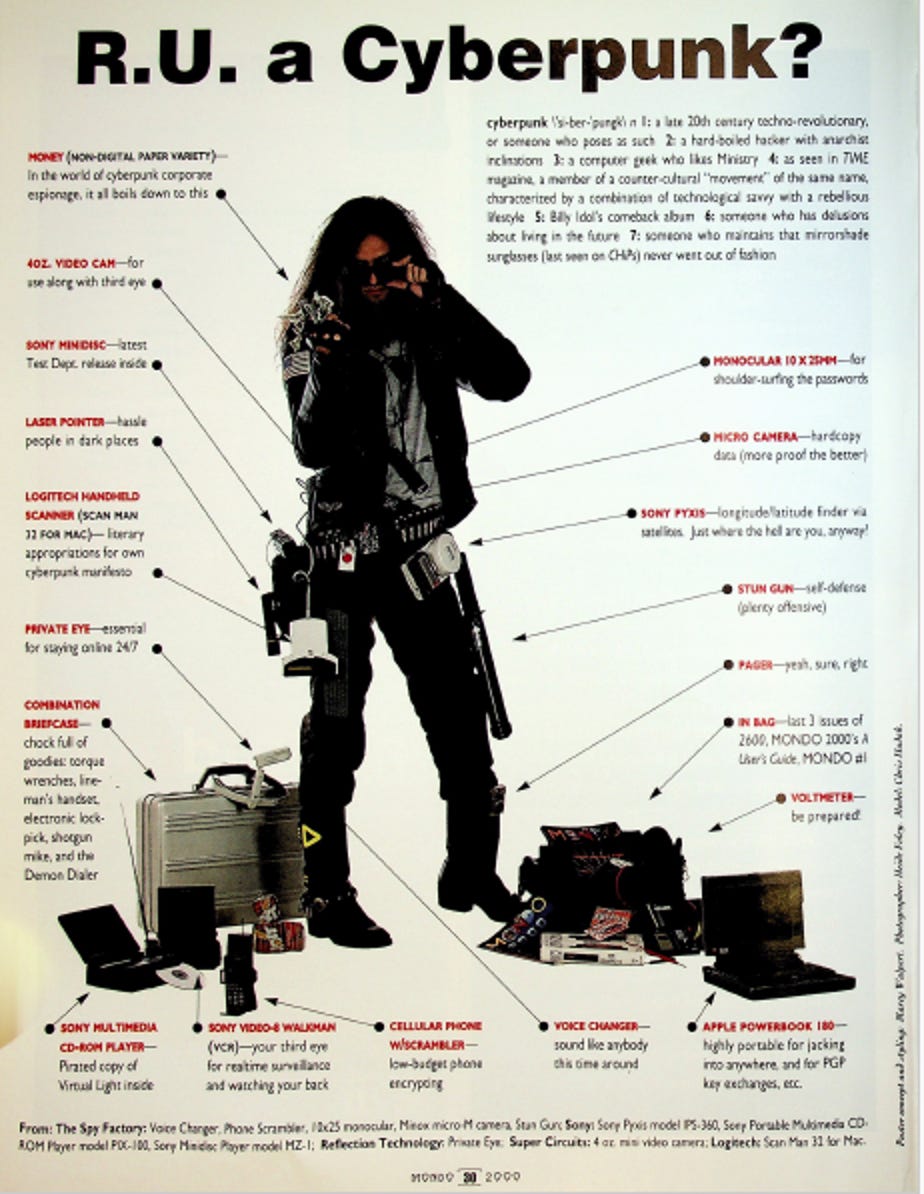
Mondo famously spoofed their own self-stylization in its 10th issue with the one-pager “R.U. a Cyberpunk” (modeled by Chris Hudak).6
But long before the parody, Mondo pushed towards the real thing. In fact, the first issue of Mondo 2000 carried a “cyberpunk” theme (including interviews with Gibson, Sterling, Vinge, and Shirley).7
That theme, by many accounts, was the brainchild of Synergy, who – in addition to scouting for content – also interviewed Vinge and the producers of the late 1980s Max Headroom show, which Synergy declares was “the premier expression of cyberpunk.”8 According to Mondo music editor Jas. Morgan, Michael Synergy “midwifed” the issue theme, practically living in the techno-gothic citadel where the mag was produced. “Anything in that issue having to do with cyberpunk came from Synergy” he said, adding that “Michael Synergy was a truly knowledgeable person.” And it was surely the novelty of the cyberpunk theme that helped the magazine garner attention.
Here he is in 1990, introduced as a “star” of cyberpunk (and a “legitimate cyber hero”) in a documentary about cyberpunk:
By the way, that documentary footage (more of it to come), is the only visual I have of him.9
Synergy was a ghost, leaving minimal fingerprints of his real life. In that first Mondo issue, he is listed as “A rising star in the cyberpunk firmament. While Robert Anton Wilson has been called a guerilla ontologist, Synergy might be dubbed an ontological terrorist.”
He has been described to me as medium sized, average height, in his early 20s, and relatively fit. He had a baby face.10 Early on, he wore an Indiana Jones bomber-style jacket. I was also told that at some point, he shaved his head bald and started wearing monk’s robes. Jas. recalls Alison (magazine domineditrix Queen Mu) telling Synergy, “You are looking more and more like Aleister Crowley every day.”
But – back to cyberpunk – the genre in sum could be understood as a kind of anxious expression of where we were headed, technologically and culturally. While it was born as a genre of fiction, the “punk” aspect of cyberpunk necessarily implied a DIYness and street ethos regarding how that tech might be mobilized. Sure, there were authorized, corporatized ways to get online but those that labeled themselves “cyberpunks” saw themselves as “outlaw hackers,” using tech to gain (rather than lose) autonomy.
This was the age of techno-bullshit. You didn’t need to know much to perform knowing everything, so long as no one drilled down to those pesky details. From the late 80s to the early 90s, many a bullshit artist found themselves advising well above their pay grade.
Hacker …?
When Michael Synergy first arrived at the Mondo House in 1988 (then, still called “Quail House”), he pitched himself as a hacker. His first article, “Cyber Terrorists, Viral Hitmen” wove together magic-tinged esotericism with a specific brand of hacker DIY. The article offers schematics of how a virus functions, not the code but the workflow of a virus and how it might be engineered.
His figures looked a lot like this:
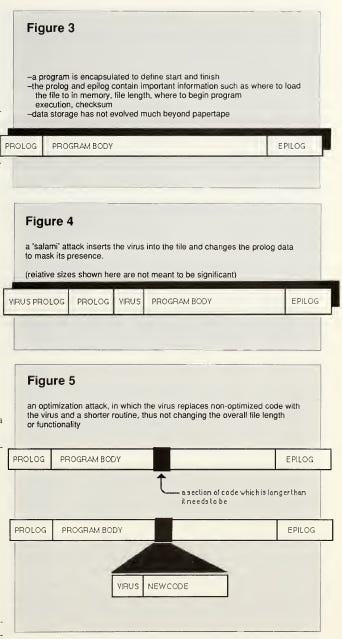
This wasn’t necessarily giving precise lessons on hacking so much as a birds-eye view of what a virus is and how it can be deployed to exploit and disrupt a system in a performative way. The article spans ten pages with nine figures and resists any inclination to pick a lane between white and black hat hacking. In other words, from the start his position was morally ambiguous.
He often spoke of computer viruses as a “beautiful lever” for disrupting, invoking change, and “moving the earth.” Here he is saying it in the cyberpunk doc:
In the third issue of Mondo, Synergy fully laid out his hacking philosophies. The article is a series of hot takes, edited and introduced by R.U. Sirius who unpacks the Synergy philosophy in a preamble: “Michael is probably the most explicitly political (anarchist division) of the young hackers. While the people in and around the Electronic Frontier Foundation are trying to gently reassure the body politic that the onslaught of information technology is not a threat to the stability of the system, Synergy will tell us how it is indeed an assault on all fronts. His message is simply ‘Surrender!’”
Some of his hot takes are standard hacker-adjacent contradictions from the era (“Information is true capital. I can’t eat gold” while simultaneously “Information can’t be stolen.”); some reads cringily in the 2020s (“I am an information addict, a sensory junkie. I want stimulus and I want it now!”); and some insights were surprisingly prescient (“With the wonders of the modern age, this is the end of the current legal system. No witness testimony is valid, sound recordings are manufacturable, photos are manufacturable, video is manufacturable.”).
In that issue, Synergy also ran an ad offering his consulting services.
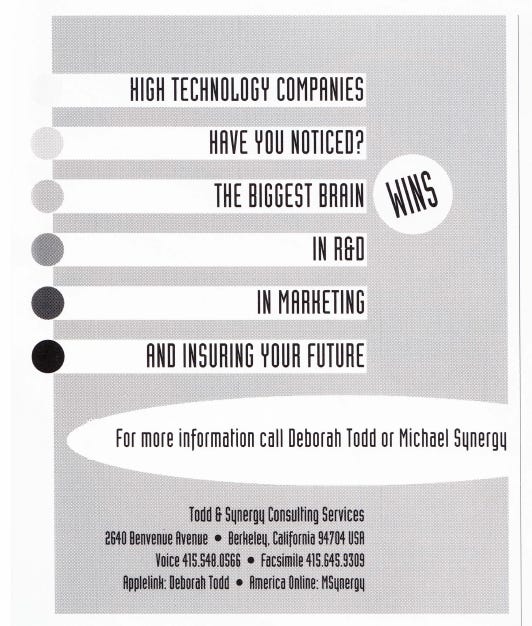
This is all well and good – some diagrams and some interesting takes on the coming tech, inflected with the cyberpunk nuance combining desire with repulsion. At the same time, Synergy’s consulting services demonstrate that his goal was less about hacking and more about entrepreneurship.
The pre-web tech scene embodied a rare moment where (with the right platform and barely enough information) one could bullshit the future into existence.
Was he worried about getting busted, publishing all of his tips? It wouldn’t seem so. Here he is (alongside CYRNAI) talking about his contingency plan for if he were captured (or in a coma, I guess):
But here’s the thing. Gracie & Zarkov, long-time writers, editors, and contributors to Mondo 2000 (who were financiers-by-day-psychonauts-by-night) say it was all bullshit. The pair considered him a close friend at one time, co-editing the conspiracy special issue of Mondo with him, and almost going into business with him.
“He wasn’t a hacker at all,” Zarkov says, later adding, “He was excellent at helping move towards the cyberpunk era. But he personally wasn’t a hacker.”
Similarly, Jas. Morgan while calling Synergy “methodological and meticulous” also suggested that Synergy might have been mentally unstable and that he has vivid and unsettling recollections of Synergy endlessly talking up his hacking skills while giggling maniacally.
The point is that despite talking a big game about hacking code and creating viruses, I’ve heard very little evidence of him actually doing it. In fact, those workflow schematics didn’t really demonstrate a hands-on knowledge so much as a strong theoretical understanding.
So, despite embodying a cyberpunk hacker ethos, it is unclear the degree to which Synergy’s hacking skill set was actual or aspirational.
Pyschopath …?
By far, the most jarring story that I have about Michael Synergy came from his former roommate, Roger Raupp, the one-issue Art Director for Reality Hackers #6.
Before you read this, a couple of caveats. Roger Raupp died in 2019, and this interview was done by R.U. Sirius, so I have no way of validating any of this story on my own. That said, Raupp told a strikingly similar story to Jamie Curcio in an interview (though using the pseud “Max” in place of “Synergy”), giving credence to the tale.
Here’s Roger Raupp’s account:
One day I woke up to find Michael sitting at the foot of my bed in lotus position, staring at me with way too much grim, unblinking aplomb. “Hey, how are you doing… what are you doing?” I ask. Michael says to me, and he didn’t seem to be joking, “oh I’ve just been sitting here for the last few hours considering how any day when I find that I haven’t killed my roommate while he slept, so that I could observe the Rorschach pattern his splattering brains would create on the wall behind his bed, is a good day, I guess.”
That episode was just the beginning. I suppose it may have had something to do with me trying to explain to him that people were comparing notes on things he had said and claims he had made, and thereby he was losing credibility: people were discovering that he had said one thing to one person and then contradictory things to another. I tried to suggest to him that he might want to chill out and stop playing so fast and loose with the truth. Dead cold silence was his only response, and ongoing, brooding iciness thereafter. I was trying to be helpful, but he may have either seen me as the instigator of his undoing or just decided to shoot the messenger in frustration.
And Michael loved to play with guns. He was endlessly reading pulp fantasy and sci-fi novels, like one or more a day, most days. He seriously claimed to be a Zen master as well as professional shaman, ninja and gambler (all at around 22 years old). Pathetic boy-man or seriously dangerous? My guts told me there was something seriously wrong there, I just wasn’t sure what the threat level might actually be. Queen Mu and I were at each other’s throats as well, so I just decided to split that scene before something tragic happened.
So, yeah. There’s that. Edgelord city. Bear in mind that this story would have occurred in roughly 1989 — before Mondo even peaked. In other words if we are to believe Raupp’s story (which I do), Synergy was like this early on.
Later – probably around 1990 – he moved in with Morgan Russell, an apartment near the east side of the UC Berkeley campus. I don’t know what happened, but that housing situation ended abruptly (I’ve been told it ended badly, though with no details) and Morgan left to go live with videographer (and sometimes Mondoid) Faustin Bray in Marin. Morgan died in 2018 and his older interviews never referenced Synergy so that one will likely remain a mystery.
Multimedia artist and musician CYRNAI dated Synergy in 1990, detailing their relationship in her journals. Synergy introduced her to Mondo, and she illustrated in the first issue. She describes a relationship that was meaningful, though also like “living in a minefield.” He confided about his “hacker life,” but his later disappearance was a “ticking time bomb.” She says that years later someone called her looking for him, saying that he “took some investors for a ride and owed over 100K.” Today, CYRNAI reflects, “Legacy can also include character failure along with notoriety. People have memories.”
All of this gels with what Jas. once told me: “Michael Synergy had a certain level of amorality.”
I once asked R.U. Sirius why he would keep Synergy on staff, given all these unsettling tales, and he replied, “The thing is, Synergy produced excellent, indeed cogent material for the magazine.” <eyeball emoji>
Was he an actual psychopath? Much like the authenticity of his hacking skills, I suppose we will never know.
Spy …?
All of this leads to the last act of the giant shrug emoji that is/was Michael Synergy: it’s possible that he was on the payroll of a three-letter agency.
To be clear, most of those claims came from Synergy himself. Here’s Roger Raupp’s breakdown of the self-myth:
Michael basically claimed to be on the run from the NSA. In his teens he had supposedly been caught hacking into sensitive military/intelligence databases. As a result, he had been forced to work for the spooks or suffer the consequences. The spooks gave him specialized training. He acted like he was Jason Bourne or something. Strange people were always just across the street watching him. The thing is I did repeatedly witness Michael being visited by a man who others in the Berkeley scene identified as a Naval Intelligence officer who had been shopping at the local “alchemists” pharmacies. Whenever Michael got a visit from this guy, he was left swimming in cold, hard cash.11
There are other, smaller stories about his relationship to three-letter agencies. Jas. told me that he once (jokingly) referred to Synergy as a “mole” and Synergy’s response was far more defensive and angrier than he would have expected. This was a theme in several stories, and I’ve been told he became paranoid when those kinds of topics arose.
Gracie and Zarkov concede that he was likely connected to some kind of government agency, but not with depth and that he “couldn’t make anything out of it.” He was rumored to have previously been in the Navy, although beyond that is unknown.
There’s a seeming inherent contradiction here, between someone who outwardly posed themselves as being rhetorically anti-government but simultaneously pandering to the state. Synergy regularly spoke of being “more powerful” than government agencies.
Yet, two beats later he declared that he might have plans to take down any government that gets too powerful:
There’s an answer here, though a slightly uncomfortable one. It’s possible that he was working for an agency, but not in the way he implied or perceived. After all, there is a value of employing the loudest person in an underground quasi-illegal scene; that person will always draw people in. No matter who Synergy was, his writings galvanized an idea of hacking, which potentially created a honey pot to find the others.12
In other words, if Synergy did have connections to any three-letter agencies then it was most likely as a narc.13
But (by far) my favorite Synergy story comes from tech pundit Howard Rheingold in an interview he did with R.U. Sirius many years ago.
Michael Synergy is an interesting story. Michael Synergy was sort of their hacker guy. If you’ve seen the TV show Burn Notice, Michael’s actually the same guy who created that. He went from being a cyberculture hacker to being a kind of military intelligence hacker, just like the guy in that show. And if you watch Burn Notice, you’ll see a producer credit to a fellow by the name of Michael Wilson. That’s not his name. Just as Michael Synergy wasn’t his name, I don’t know what his name was. But I know having some communication with him that they were the same person. So, you know, it was just an interesting combination there.
That’s right. According to Howard Rheingold Michael Synergy eventually created the pro-NSA hacker show Burn Notice. The showrunner for Burn Notice wasn’t named “Michael Wilson” although there was someone with that name listed as a consultant for 13 episodes. That Michael Wilson has no other IMDB credits to his name.
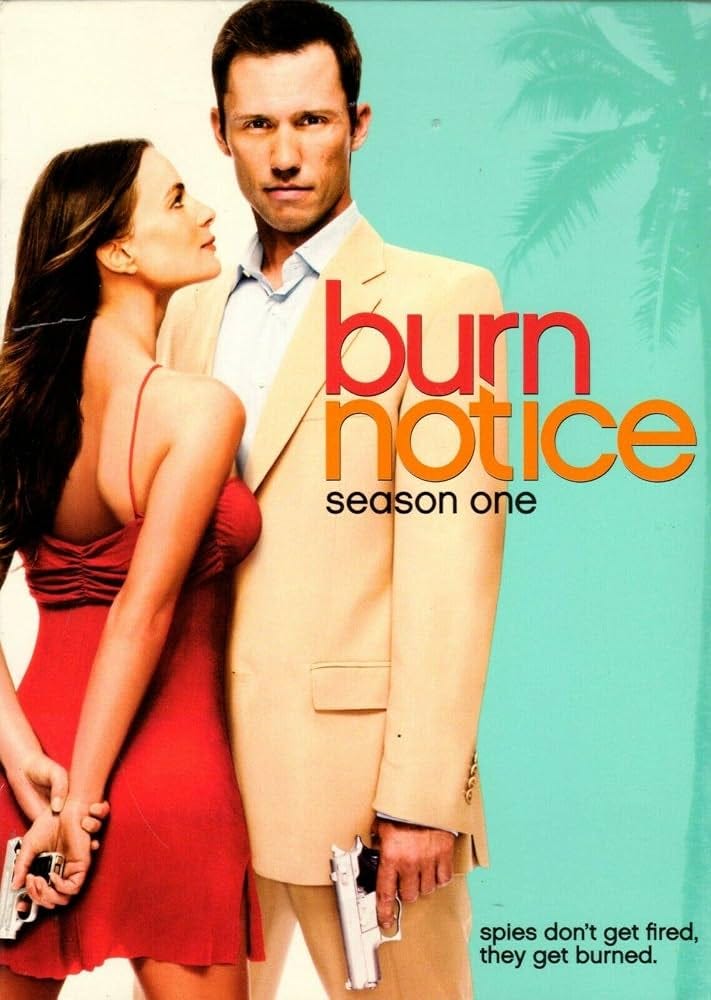
When I asked Gracie about this one she seemed skeptical. “I mean, I think he had the moxie and the connections to understand that scene. But I don’t think Michael had the fundamental business capability to get anything like that done” adding, “The thought of him being a producer or manager is just completely mind blowing to me.”
So who the fuck was Michael Synergy?
Most of my other Synergy-adjacent stories run cold. I know that he was briefly married (then divorced) in the early 90s.14 Someone told me that they saw him at a conference in the early 00s. Before she died in 2003, St. Jude hunted him down at one point and reported that he eventually moved to Florida and was living with his grandmother.
The rest is a mystery.
But I think it’s worth, one last time, to turn back to the word “synergy.” It’s easy to forget that it wasn’t always a punchline nonsense word that makes middling managers froth at the mouth. It was also embraced by the counterculture and New Agers that saw the term more like a kind of energetic harmonization.15 This version of “synergy” was (and remains) popular among artists, musicians, and magicians to articulate creative collabs. The concept of synergy offered a rejoinder to the implied nihilism of late 20th century entropy. (Obviously, Michael Synergy probably was not anti-entropy but still borrowing on the cache of the term and its value in the counterculture.)
I think that Michael Synergy, whoever he was, saw the idea of “synergy” not as himself playing the role of cog-in-wheel but as the wheel, itself. His voice was synergistic in the sense that he managed to tie together the disparate threads of conversation within hacker culture, harmonizing all of the voices from the scene and packaging them in a way that people from outside of the culture could understand, whether those people were aspirational techies, corporate blowhards, or government agencies.
As Gracie & Zarkov told me, “He was synergizing his place in the futurist cyberpunk mise-en-scene via his skill at performance of bullshit.” That, too, is a kind of hacking.
Because, of course, hacking wasn’t ever just about computers and certainly wasn’t always about the internet.16 To hack a system, to exploit a system, means revising it for the hacker’s own purposes. Sure, that system might be digital but it could just as easily be an interpersonal relationship, a media outlet, or a (viral) scene. Michael Synergy, if nothing else, surely knew how to hack a scene.
OK folks, that’s this month’s weird Mondo tale. I am willing to entertain any requests! If you were a Mondo reader or part of the scene and want to hear about characters, issues, or specific stories, hit me up in the comments. Freaks in the Machine: Mondo 2000 in Early Tech Culture will be out in early 2027. In the meantime, you should grab a copy of my latest book The Unseen Internet.
To be clear, I’ve been told his “real” name, but if any of the stories below bear out, it is just as likely this name was fabricated, as well. I’m choosing not to share the relatively generic last name because of the nature of those stories and my inability to validate most of them with certainty.
I decided against using the excellent audio footage in this (because the video worked better) but it was hosted by Don Joyce from Negativland, produced by R.U. Sirius and Ed Tywoniak. It makes for a great listen.
I guess there’s also a third possible reader: If you are Michael Synergy reading this article… I guess… email me, Bro…? Or actually, given the nature of these stories maybe don’t? I’m conflicted.
Autodesk is a Bay Area software corporation best known for AutoCAD, a 2D/3D design visualization program, popular in the 80s and 90s. In the late 80s they were toying with Virtual Reality and development of the Cyberspace Developer Kit, headed up by Mondo regular Eric Gullichsen. Morgan Russell became part of High Frontiers in 1987, a bit before he began working at Autodesk. I’ve been told that at Autodesk Synergy was assistant to Ted Nelson, the man who coined “hypertext.”
Assuming that was his real surname. But I question the logic of publicizing illegal activity under a name that closely aligns with one’s real name, and I remain dubious.
After leaving Mondo, St. Jude, R.U., and Bart Nagel would go on to write The Cyberpunk Handbook (Fakebook), also a parody.
In fact, the Gibson interview was not actually an interview. It was a recorded drunken “business” conversation between him and Timothy Leary, and he was less than thrilled to see it in print.
I actually have a lot of thoughts about Max Headroom, having recently re-watched it, but I’ll spare you and save that for a future post.
For those who are interested, here’s the link to the full video.
In fact, I have been told that he may have been in his late 20s, the baby face masking his true age.
I just want to take this opportunity to say that this account of a navel officer visiting and leaving him “flush with cash” doesn’t necessarily mean that he was an operative. There are all kinds of reasons this might have occurred.
“Find the others,” of course, was the rallying cry of Tim Leary in this era. However, “finding the others” to report them to agencies does not necessarily align with the Leary ethos (although some might argue the point).
Just to be clear, I am using “narc” in the colloquial. I don’t think he was a narcotics agent, but I do believe that could have easily been an information gatherer and informant. That said, Gracie & Zarkov say they never heard stories nor rumors of anyone getting busted for anything, based on information from Synergy.
I do have a smidge more information about this story, but have been asked not to share it.
It’s important to remember that all of this takes place only a handful of years after the so-called “harmonic convergence.”
The original use of the term was adopted from MIT’s Tech Model Railroad Club. And one of the most infamous hackers of all time, Captain Crunch, was best known for blowing whistles into phones.
Excellent article. Also I owned the Mondo 2000 with that R.U. a Cyberpunk? ad. I remember William Gibson (I think?) commenting on it years later that people didn't understand that it was a joke.
I'm not willing to let the term synergy go. I first encountered the term while reading Ruth Benedict. (I even thought she invented the term.) She developed it while trying to find a term for the societies she felt drawn to. I find her definition extremely useful. High synergy societies match individual interest with collective issues. Making up a story about hunting. A high synergy society would let a successful hunter brag about his or her prowess and get first choice of shares before the rest is divided up. Low synergy societies would either give the hunter all of it or divide it up equally among everyone with no acknowledgment of the hunter's accomplishment...both are low synergy systems. I used this insight when I had a small department at a Berkeley hippie backpacking company. We'd discuss company goals and personal goals and work at performance objectives that advanced both.